passwords4 min
Strong Passwords: Length and Randomness
Learn what a password generator can and cannot guarantee, why length and randomness matter, and how to store unique passwords safely.
Read more→Free secure password generator using Web Crypto API. Adjustable length, character types, entropy analysis, and bulk generation. No sign-up needed. Try now.
Processing: local in your browser
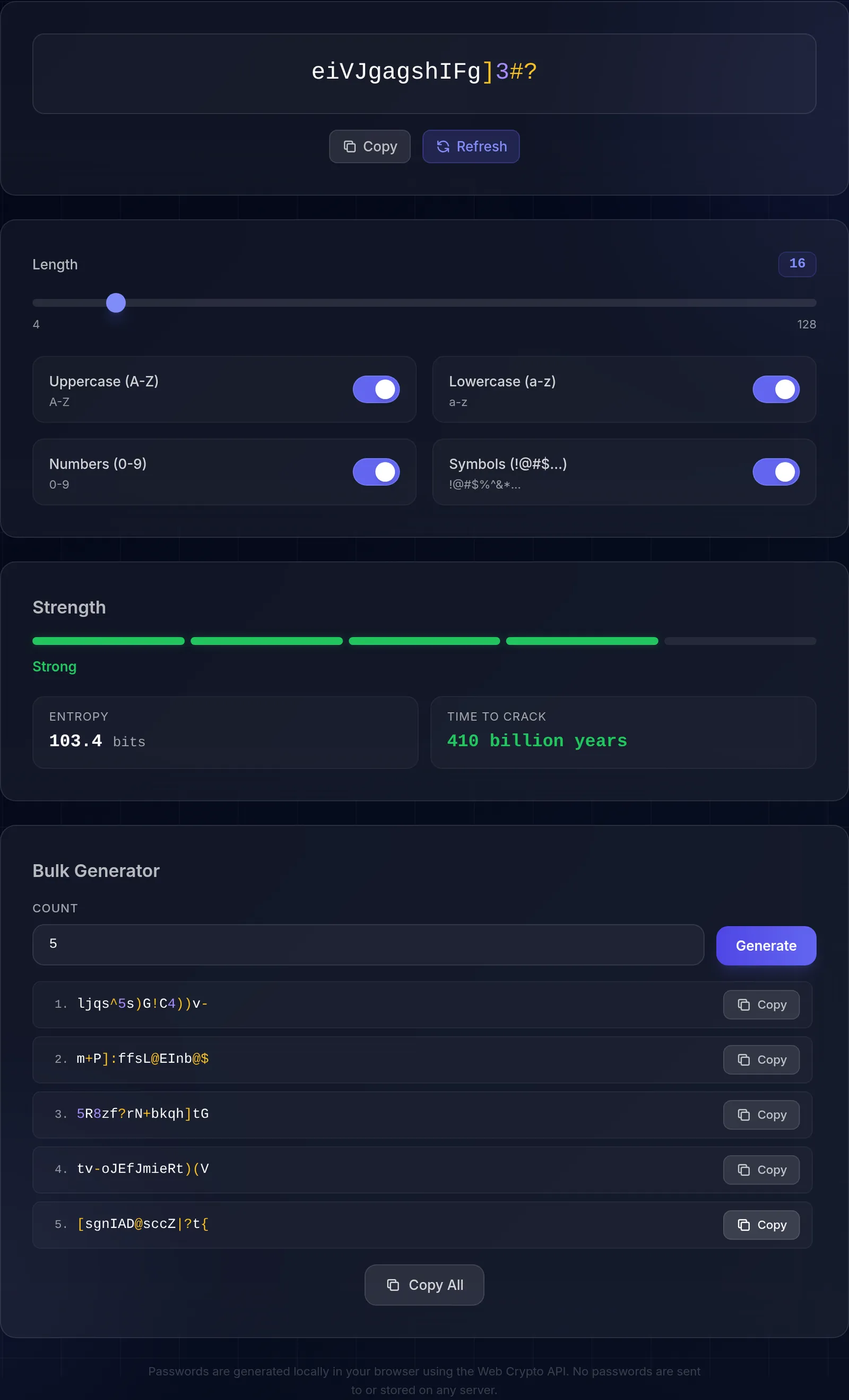
Generate cryptographically secure passwords using the Web Crypto API. Customize length, character types, and analyze password strength.
Includes visual strength meter, entropy calculation, brute-force time estimation, and bulk generation of multiple passwords.
Local cryptographic generation, entropy analysis in bits, brute-force time estimation, support for uppercase, lowercase, numbers, and symbols.
A strong password combines three key factors: length, complexity, and uniqueness. Length is the most important factor: each additional character exponentially multiplies the number of possible combinations. A minimum of 16 characters is recommended for important accounts. Complexity means mixing uppercase letters, lowercase letters, numbers, and special symbols, which vastly expands the search space for an attacker. Uniqueness means never reusing passwords across different services; if one leaks in a data breach, your other accounts remain protected. Avoid dictionary words, proper names, birthdates, or predictable sequences like 123456 or qwerty. Our generator creates random passwords that automatically meet all of these criteria.
Entropy measures the unpredictability of a password in bits. The more bits of entropy, the harder it is to crack through brute force. An 8-character password using only lowercase letters has approximately 38 bits of entropy, which a modern computer can break in minutes. Adding uppercase, numbers, and symbols raises the entropy to about 52 bits. Increasing the length to 16 characters with all character types can exceed 100 bits of entropy, which would take billions of years to crack with current technology. Security experts recommend at least 60 bits for general accounts and over 80 bits for critical accounts like online banking or your primary email. Our generator displays the exact entropy of each generated password and estimates the time required to crack it.
An alternative to random passwords is the passphrase: several random words strung together, like "correct-horse-battery-staple". Being long, they reach high entropy, and being made of words, they are easier to remember and type than a string of symbols. The key is that the words be genuinely random, not a meaningful sentence or a well-known quote. For accounts you must memorize, a four or five random-word passphrase usually offers the best balance between security and memorability.
Generating strong passwords only helps if you then manage them well. A password manager stores each one encrypted and fills forms for you, so you can use unique, long credentials without memorizing them. Add two-factor authentication (2FA) wherever a service offers it: even if a password leaks, the second factor blocks access. This tool generates passwords in your browser and does not store them; copy them into your manager and do not send them over insecure channels like email or chat.
We generated 2,000 passwords of 128 characters with this generator and counted every symbol: 256,000 draws over an 88-symbol alphabet. A uniform source would put 2,909 of each symbol in that sample; we observed between 2,795 and 3,035, a widest gap of 4.3% — 2.3 standard deviations, which is ordinary across that many symbols. All 2,000 came out distinct.
Measured on with Chromium 151.0.7922.173. How we measured it
Learn more with related in-depth guides and tutorials.
Learn what a password generator can and cannot guarantee, why length and randomness matter, and how to store unique passwords safely.
Read more→Understand static QR payloads, error correction, quiet zones, sizing, privacy, and how to verify a code before printing it.
Read more→Use provenance, real file type, hashes, macros, and malware scanning as layers of evidence—without mistaking a clean result for proof of safety.
Read more→Passwords are generated locally in your browser using the Web Crypto API. No passwords are sent to or stored on any server.